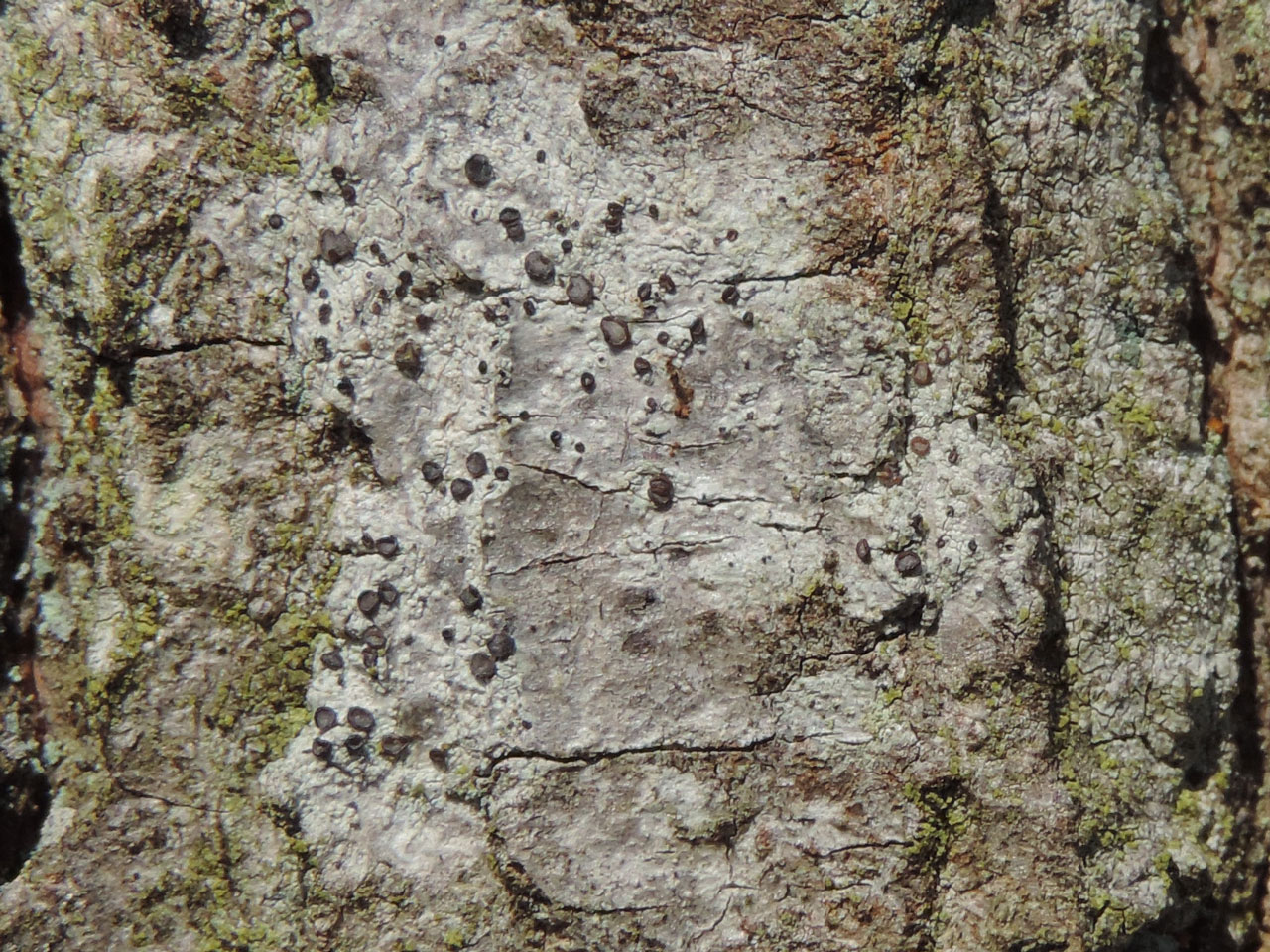
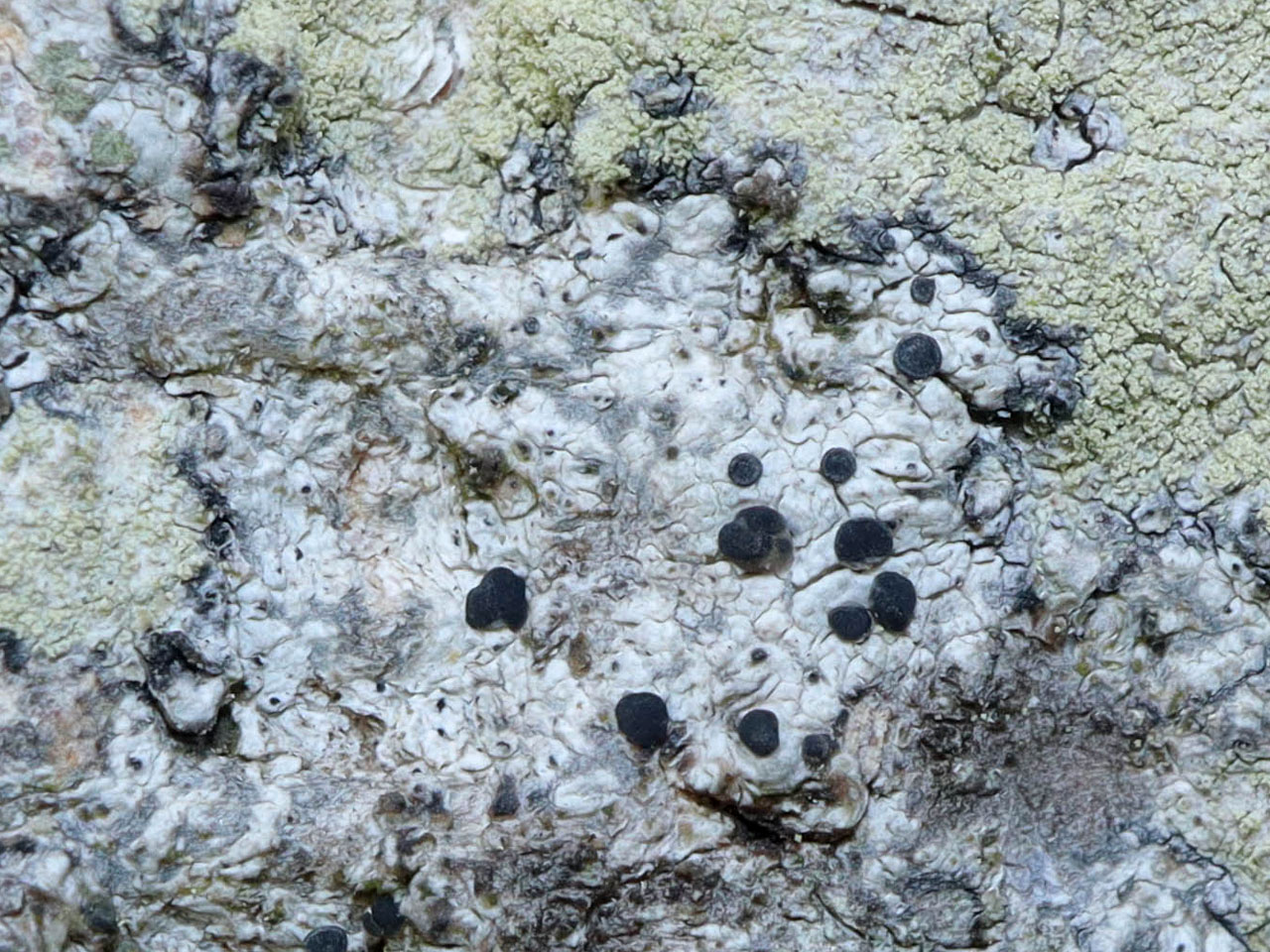
This very common lichen is easy to identify when well developed by the combination of whitish to pale grey thallus, pink-brown to dark brown-grey or blackish, sometimes ± piebald disks with a distinct margin, which are accompanied by pycnidia which form frequent black dots. However, odd forms, sometimes lacking pycnidia, or alternatively lacking apothecia, occur and can fool even experienced lichenologists. Microscopic examination will normally sort these out.
Thallus variable, whitish to pale grey or blue-grey, matt or slightly glossy, continuous, smooth to warted-areolate. Apothecia 0.2–0.6 (–0.8) mm diam.; disc concave-flat or slightly convex, often thinly white-pruinose, pink-brown to dark brown-grey or blackish, sometimes ± piebald; true exciple thin, paler or concolorous, in section colourless or brown (K+ purplish tinge) at the upper outer edge, ± densely granular internally; hymenium 55–60 µm high, paraphyses with ± clavate apices. Ascospores 8–16 × 2.5–3.5 µm, (0-) 1 (-3)- septate, narrowly cylindric-ellipsoidal. Pycnidia 0.1–0.2 mm diam., usually present as black dots, the wall K+ purple; conidia 3.5–4.5 × 1.5–2 µm, ovoid to ellipsoidal. Thallus K+ yellow (atranorin, roccellic acid).
Very variable. The thallus is commonly smooth and thin, but is sometimes thick, irregularly warted or corrugate; the latter morphs are often confusing but usually bear the characteristic dark pycnidia, the walls of which are K+ purple. Apothecia are often notably variable in colour on the same thallus. When on rocks it can be separated from Tylothallia biformigera by the pigmentation of the pycnidia, the generally thinner thallus and the chemistry.
Sterile material with large pycnidia at or above the range given here and found on hard worked timber and rarely dead wood needs futher investigation; it has been recorded as Cliostomum corrugatum, but is very unlikely to be this species, which is a veteran tree specialist.
Most frequent on the dry sides of the bark of mature trees including conifers and wood, often in rather dry, well-lit situations, more rarely on sheltered, ± vertical rock faces or walls, Calluna stems and low shrubs, also decaying Armeria tufts.
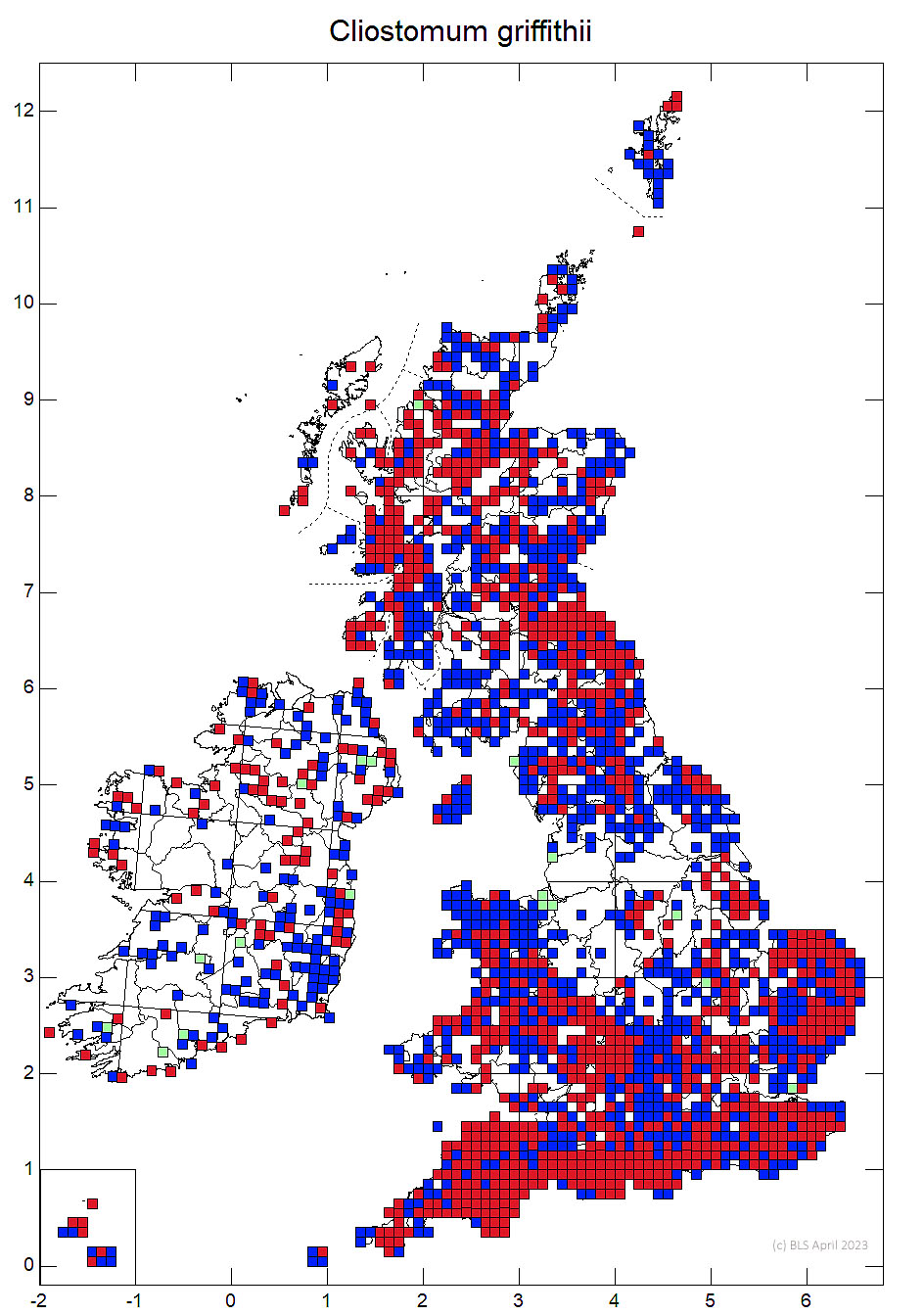

Abundant, throughout Britain and Ireland.
Cannon, P., Ekman, S., Kistenich, S., LaGreca, S., Printzen, C., Timdal, E., Aptroot, A., Coppins, B., Fletcher, A., Sanderson, N. & Simkin, J. (2021). Lecanorales: Ramalinaceae, including the genera Bacidia, Bacidina, Bellicidia, Biatora, Bibbya, Bilimbia, Cliostomum, Kiliasia, Lecania, Megalaria, Mycobilimbia, Phyllopsora, Ramalina, Scutula, Thalloidima, Toninia, Toniniopsis and Tylothallia. Revisions of British and Irish Lichens 11: 1-82.
Text by Neil A Sanderson based on Cannon et al (2021)