Lecanora pulicaris
Lecanora pulicaris f. pinastri
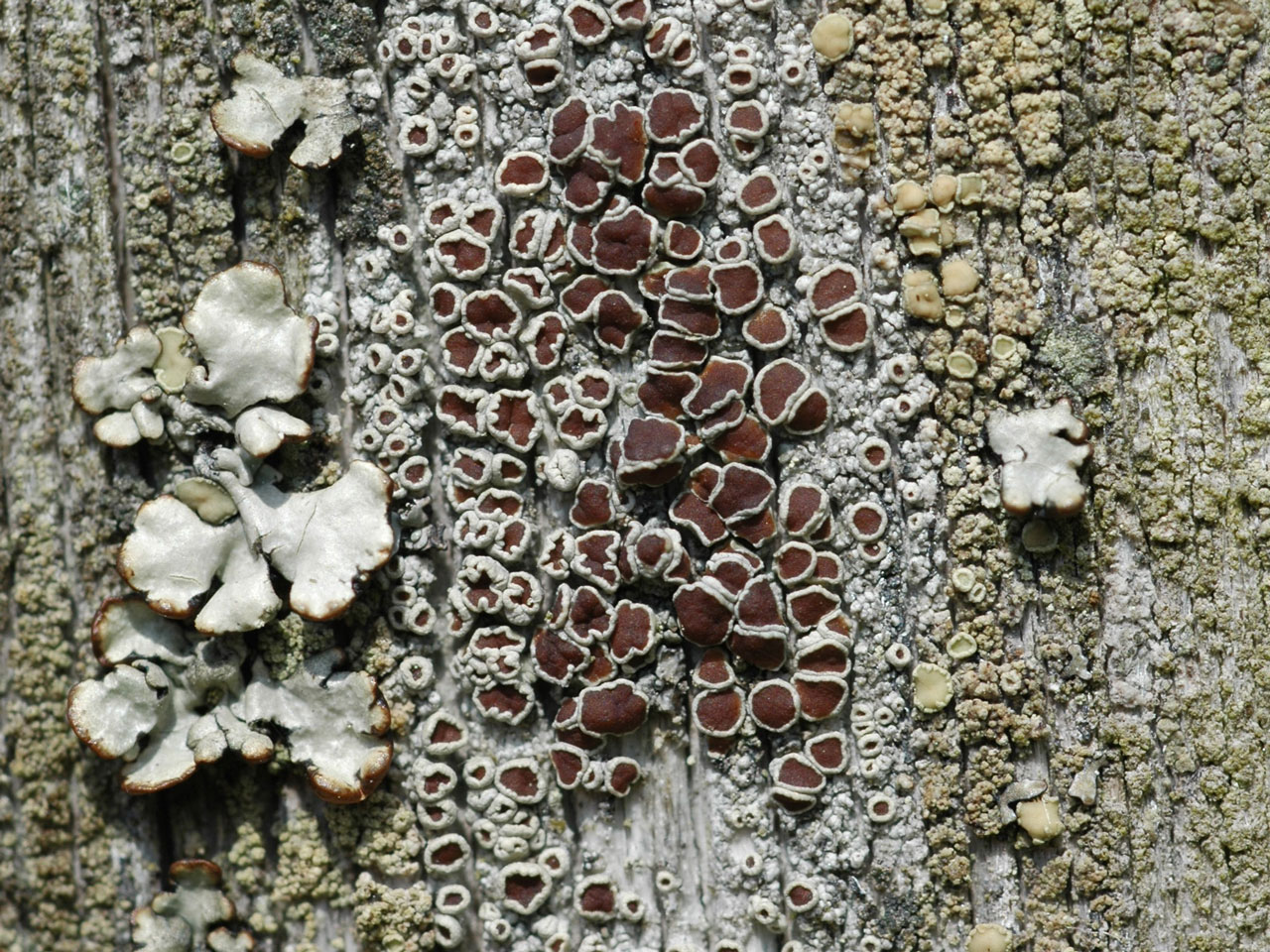
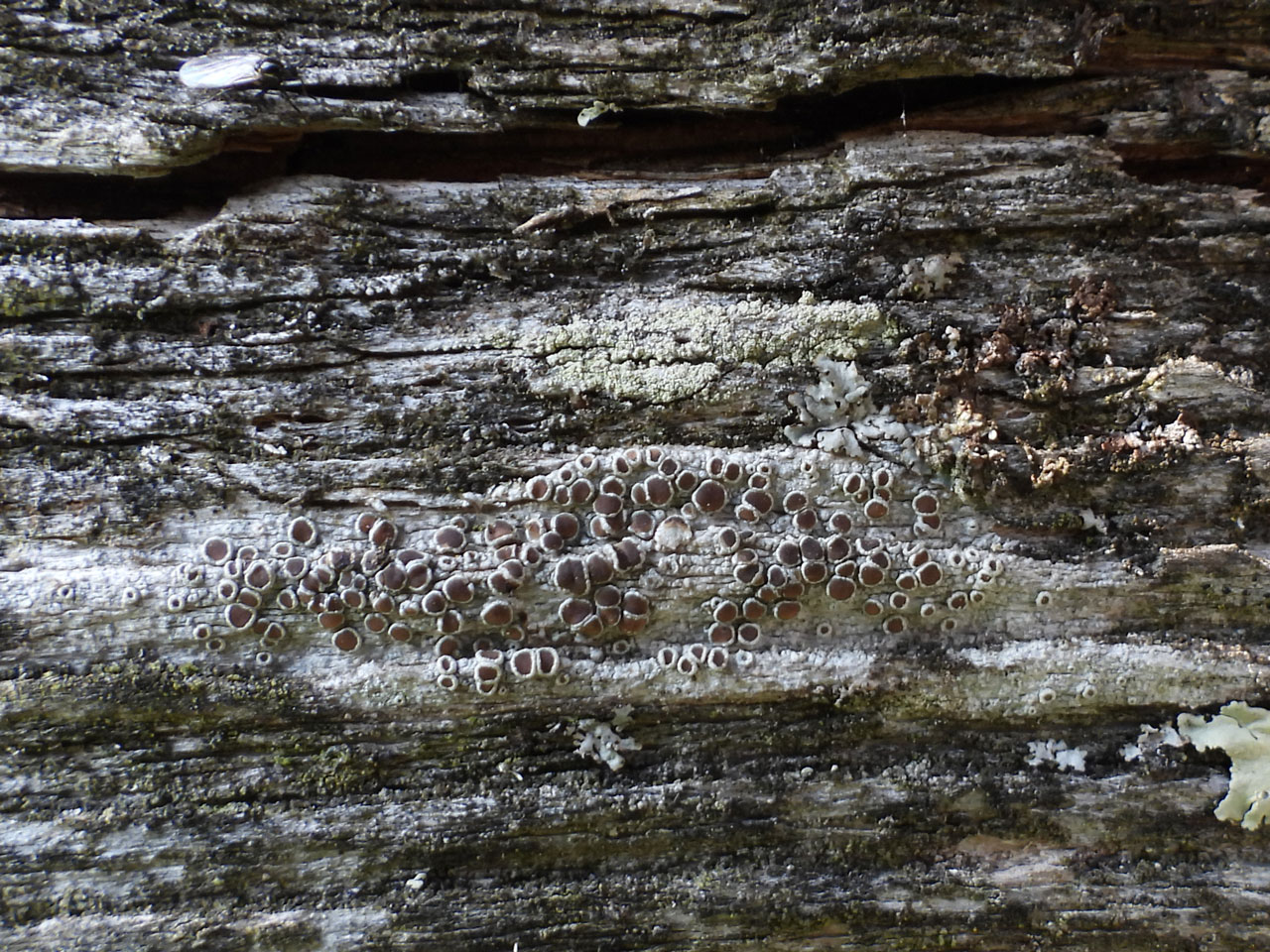
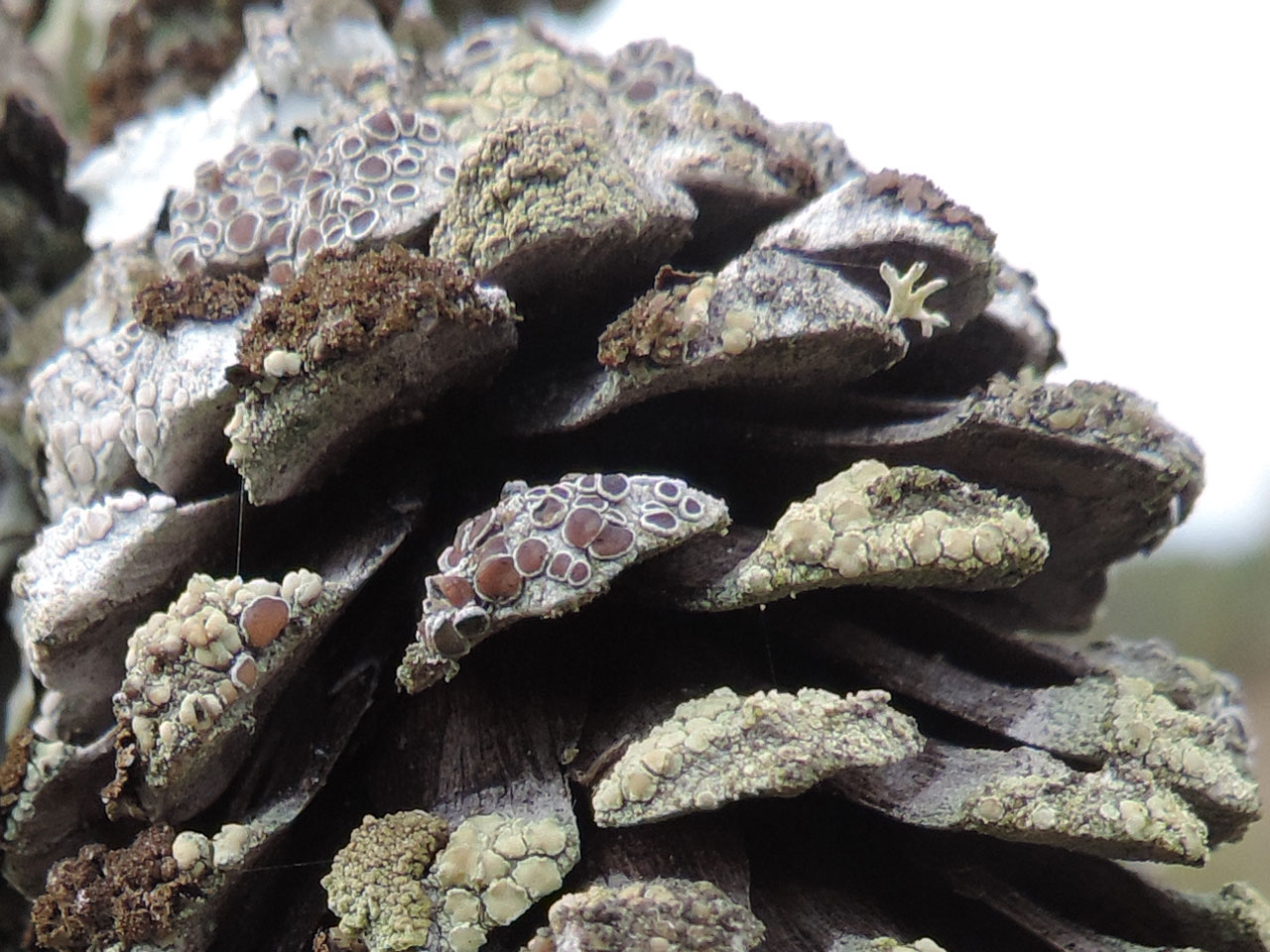
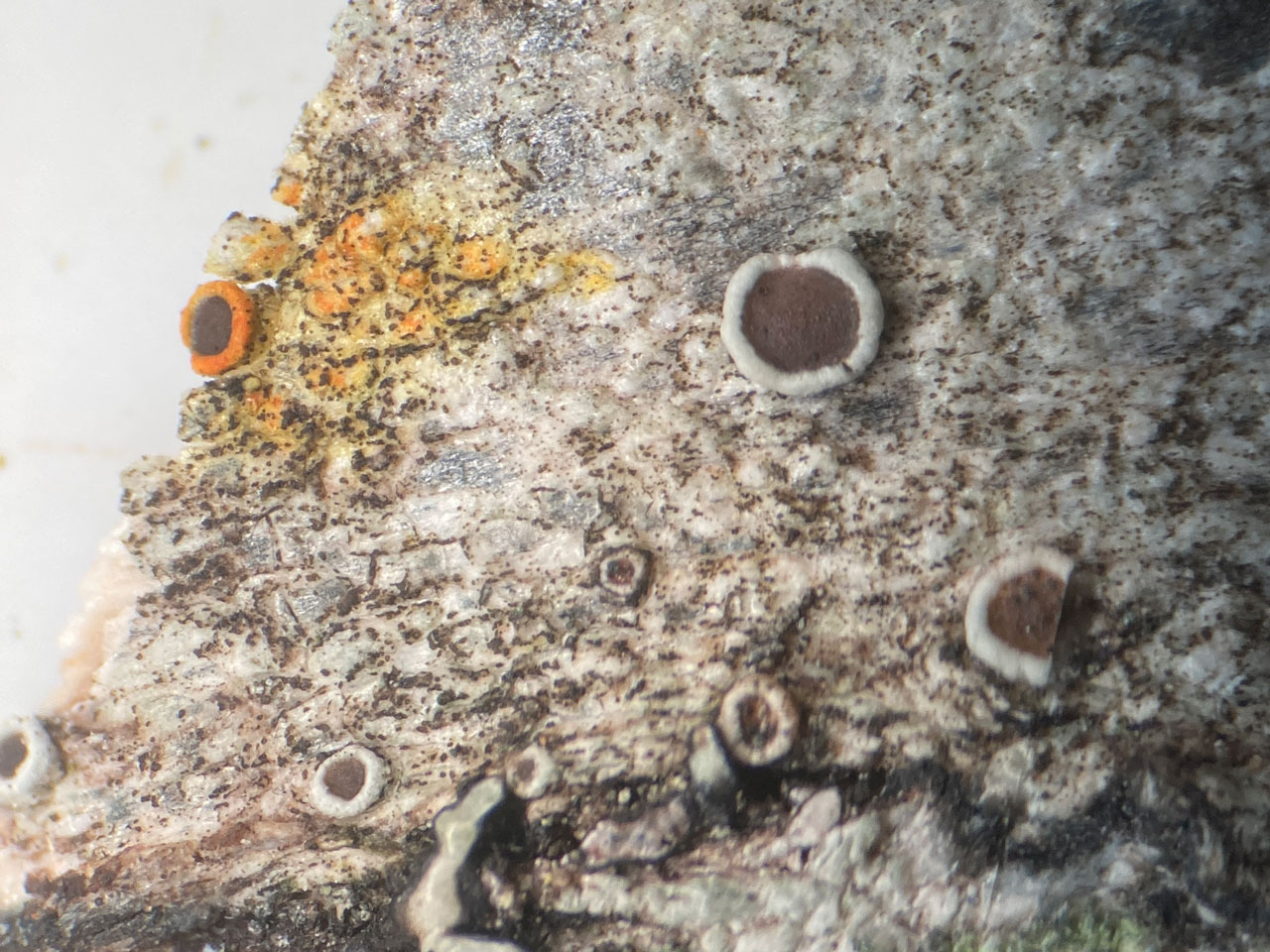
A member of the L. subfusca group (see Lecanora chlarotera s. lat. & Lecanora chlarotera s. str.) found widely on acid lignum and bark. Distinguished by the combination of a red-brown disk, Pd+ orange red thaline margin and by the epithecium granules being on the surface and interspersed between paraphyses. The acidic habitat is also good indication to look for candidates to check. Lecanora argentata and Lecanora pseudargentata also have darker disks but have Pd± pale yellow margins, are found in less acidic habitats and have different distributions of epithecium granules.
Thallus continuous, often thin but generally clearly delimited, yellow-white to grey, surface smooth to roughened or warted; soralia very rare, 0.1–0.2 mm diam., when present green-white (these possibly the result of misinterpretation of thallus erosion/fragmentation); prothallus white, blue-black or absent. Apothecia 0.3–1 (–1.5) mm diam., sessile, somewhat constricted at the base; thalline margin well-developed, entire to slightly warted, persistent, medulla with large crystals not dissolving in K; disc red-brown or black, ± flat; epithecium red to orange-brown, with granules on the surface and interspersed between paraphyses dissolving in K but not N; hymenium 60–85 µm tall; paraphyses 1.5–2.5 µm diam., unbranched or sparsely branched, apices to 3.5 µm diam., not or slightly swollen. Ascospores (9–) 11–15 (–16) × (6.5–) 7.5–9.5 (–11) µm, broadly ellipsoidal. Thallus C–, K+ yellow, KC–, Pd+ orange red (sometimes confined to the thalline margin; Pd– morphs not yet reported from our region), UV–, reflecting UV mauve-purple light (atranorin, fumarprotocetraric acid, ± roccellic acid).
A member of the L. subfusca group (see Lecanora chlarotera s. lat. & Lecanora chlarotera s. str.). Distinguished by the combination of a red-brown disk, Pd+ orange red thaline margin and by the epithecium granules being on the surface and interspersed between paraphyses. The acidic habitat is also good indication to look for candidates to check. Lecanora argentata and Lecanora pseudargentata also have darker disks but have Pd± pale yellow margins and different distributions of epithecium granules. Rare forms with crenulate apothecial margins, pale discs and lacking fumarprotocetraric acid are almost indistinguishable from L. hybocarpa s. lat. See also L. cinereofusca.
On decorticated wood, worked timber and the acidic bark of both coniferous and deciduous trees.
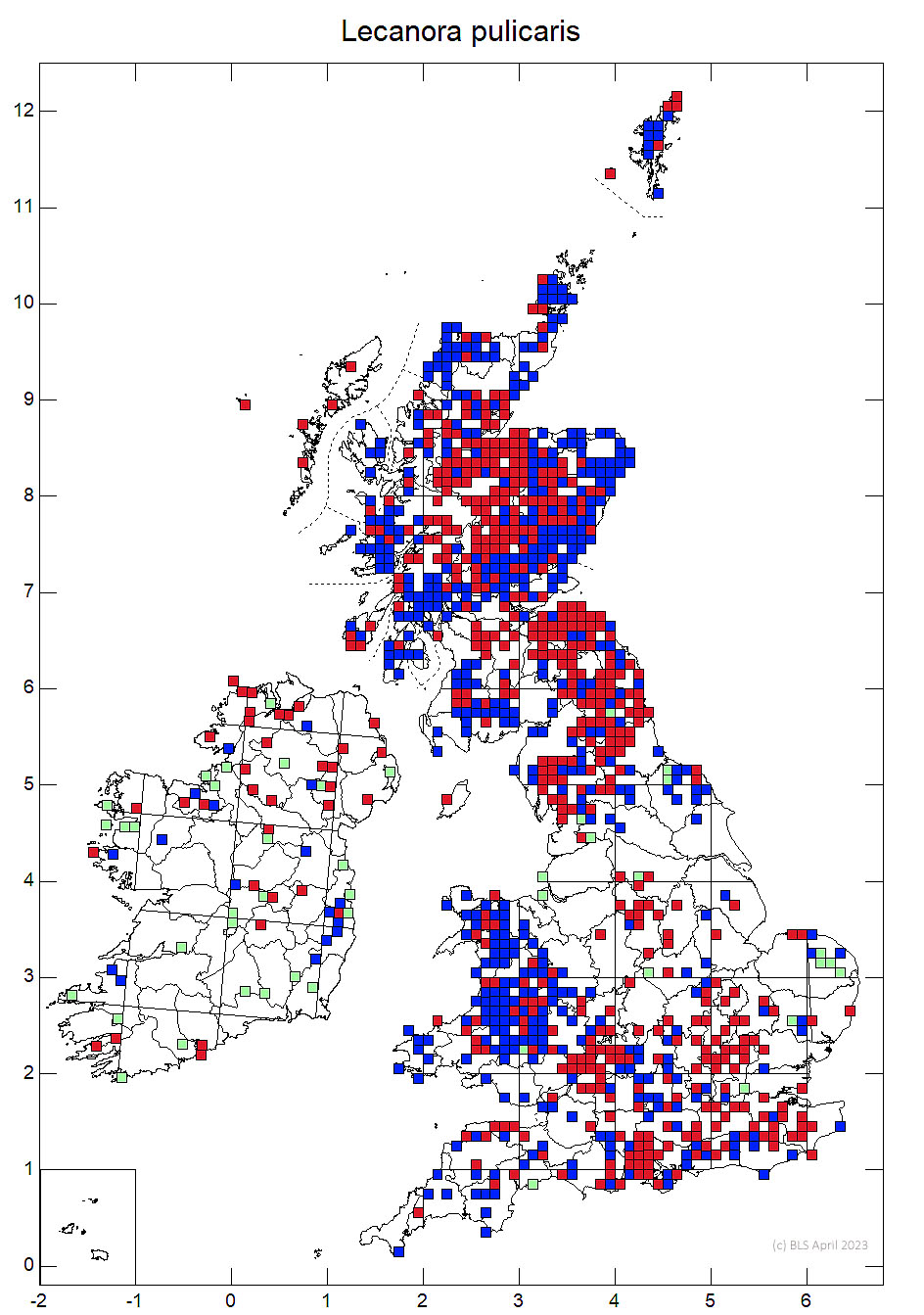

Widely distributed, most common in N.E. England & Scotland.
Cannon, P., Malíček, J., Ivanovich, C., Printzen, C., Aptroot, A., Coppins, B., Sanderson, N., Simkin, J. & Yahr, R. (2022). Lecanorales: Lecanoraceae, including the genera Ameliella, Bryonora, Carbonea, Claurouxia, Clauzadeana, Glaucomaria, Japewia, Japewiella, Lecanora, Lecidella, Miriquidica, Myriolecis, Palicella, Protoparmeliopsis, Pyrrhospora and Traponora. Revisions of British and Irish Lichens 25: 1-83.
Text by Neil A Sanderson based on Cannon et al (2022)